This is a long post, so pull up a cup of tea and settle in.
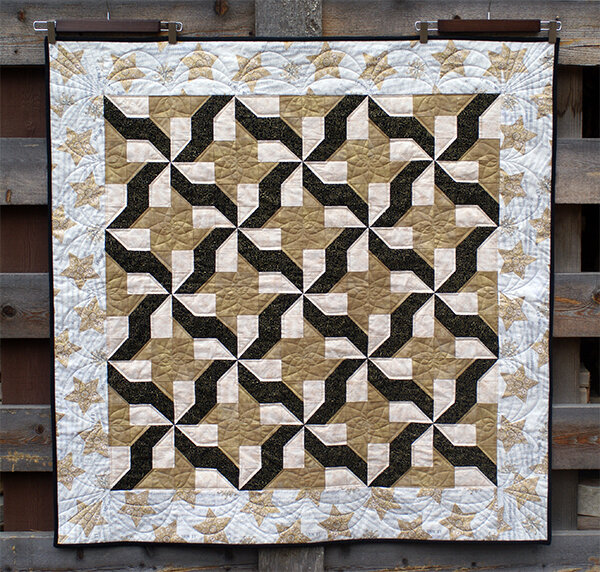
The other day, I felt compelled to get the basted Beginner’s Choice wallhanging out to be quilted. If you will recall, this is a Laura Wheeler block that I believe was intended to be simple—a nine-patch composed of squares and half-square triangles, which would indeed make it suitable for a beginner—but somehow morphed into a much more complicated block consisting of trapezoids and chisels. I have not been able to find the simpler block anywhere, but the more complicated ( = not beginner) version appears in both Jinny Beyer’s Quilter’s Album of Patchwork Patterns and in the BlockBase program.
I made a wallhanging featuring this block using Christmas fabrics. I was mostly playing around, although this is on the “to be re-done and published” list for a future date. I can’t tell you exactly what motivated me to get it out and work on it, but clearly my brain had some itch that needed to be scratched. I know that wanting more practice with my longarm rulers factored into the decision.
One of the first things Angela Walters said in the class I took from her was that no one gets better at machine quilting without practice. (That holds true for most things.) I have worked hard at adopting a mindset that will allow me to play around with my quilted stuff without assigning super-high expectations of perfection. Angela Walters is in my head a lot:
Practice, practice, practice!
Done is better than perfect!
Every master was once a disaster!
I very much appreciated the video in which Angela shared some of her very first longarmed quilts and pointed out just how awful they were.
The last couple of months have been a journey of getting to know the Q20 and forcing myself to quilt things other than loops. But I find myself getting caught up in quilting design decisions—as if designing the actual quilt top itself wasn’t fraught with a myriad of choices—and having to fight my way through the various pieces of conflicting advice I am hearing. I said to the husband yesterday that I know why some people buy longarm machines on frames and hook them up to computers. Letting the computer quilt an edge-to-edge design is infinitely easier than custom quilting.
But I am determined to master this.
I’m going to take a short detour here. A phenomenon I saw in knitting also appears to have infected the quilting universe. I started knitting in the 1980s. Somewhere around the early 2000s, a group of younger people found the craft, but they wanted everyone to know that what they were doing was “not your grandmother’s knitting.” I found that phrase annoying and ungrateful on so many levels. It is possible to be modern and edgy without denigrating what came before you as primitive and unsophisticated (which it most certainly was not). That attitude has made itself known in quilting, too, and it has caused me no end of whiplash:
“Don’t use polyester batting—it makes your quilts look like 1980s comforters,” only to discover that most quilt designers use either two batts, one of which is polyester or wool, or a 50/50 blend of cotton and polyester. (The explanation is that they travel and hang better on display without wrinkling because of the polyester.)
“Don’t stitch in the ditch—that’s for grandmothers” only to discover that a lot of custom quilting relies heavily on stitching in the ditch.
I am juggling a whole lot of conflicting information in my head and trying to gel it into something that makes sense for me. Read that last part again. FOR ME.
I spread out the basted wallhanging and looked at it. Amanda Murphy advises to “quilt the bones” of the design first. Quilt the structural elements and the parts you want to emphasize and then go back and add embellishments. I knew I wanted the black ribbon-y pieces to stand out, so I started there.
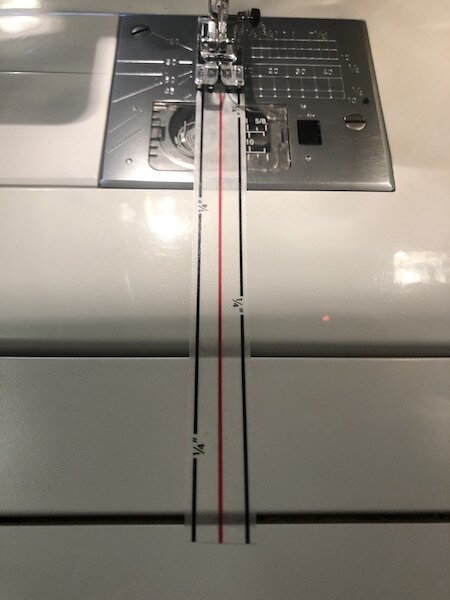
You have to remember that I was trained by a group of Mennonite quilters, and my personal aesthetic has always been more traditional than modern. I very much like the look of quilting 1/4” from the seamline better than stitching in the ditch. I quilted inside the “star” that was formed by the black fabric ribbons: