
Six Serger Students on Saturday
The Serger 101 class is an unpredictable class because I never know what machines are going to show up in what condition. (Fitting is also an unpredictable class, but in a different way, as it doesn’t require a toolbox and a bottle of sewing machine oil.) Still, the serger class is fun and challenging and I enjoy teaching it.
I had six students yesterday. One brought a machine that she found in her basement, an unknown brand (Rex) which turned out to be a clone of the White Superlock brought by another student. My T-shirt student from earlier this week brought her lovely BabyLock combo machine. Amanda—whom I have known since she was three years old and in dance class with DD#2 and who asked for the class in the first place—brought a vintage Singer she inherited from her grandmother. Another young woman had a more recent model Singer of unknown provenance. And one student had a new Brother serger, which was a bit temperamental until we changed the needles.
The Rex needed copious amounts of oil and a bit of coaxing to move; I was worried it was binding due to something like thread wrapped around the handwheel, but its owner was calmly persistent and eventually, it made a lovely stitch. I think it had just sat unused for years and frozen. The newer Singer did not want to cut the fabric even with the knife in its proper position, so I suggested to its owner that a new knife blade would not go amiss. She seemed a smart cookie and said she thought she could change it using the instructions in the manual. In the meantime, she used the blade as a guide rather than a cutting instrument and got a good result. Amanda’s Singer will make basic serger stitches but is missing some of the features of later models such as differential feed. It is also old enough that it requires special needles. Most newer sergers use household sewing machine needles.
The owner of the White Superlock was able to thread her machine successfully but the only two presser feet she had with her were an elasticator foot and a gathering foot. I had her use the elasticator foot and it worked fine for the basic stitches.
[I have a White Speedylock that I bought at the local Goodwill. It originally went to a friend of mine, who brought it back to me and said she just couldn’t make it work. That machine is upstairs in my sewing room and I am hesitant to pass it along to anyone else because it is awful—AWFUL—to thread. I can thread most sergers in my sleep. That one took me over an hour to thread. The person who christened it Speedylock obviously never had to thread it. The Superlock is a huge improvement over the Speedylock.]
By the end of class, each student had threaded her machine and made several basic stitches. The goal of that class is to demystify sergers and get the owners comfortable with working with them. I think we achieved that yesterday.
*****
One of the patterns I would like to mess around with is McCall’s 7349:
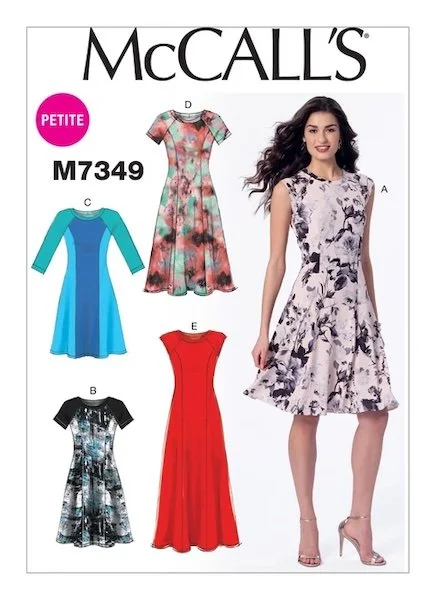
It was on sale on the Simplicity.com website a few days ago but only in PDF format. I bought it, but I did not see that it only comes in legal, letter, and A4 format. There is no A0 copyshop format, something I have been taking for granted as being included in PDF patterns these days. I will either have to print and tape together 56—yes, 56—pages or purchase the pattern in paper format. I don’t have a pattern for a garment like this, which is a combination raglan/princess seam style, and I’d like to try it.