
Sinclair Patterns Libby
I made a list of all the sewing projects I want to make and it is embarrassingly long. I said to the husband that part of the problem is that I have too many ideas and not enough sewing time. My brain is overflowing with things I want to try. What if I combined this bodice with a different neckline? Or made this top into a dress? I could lock myself in my sewing room for a month and do nothing but sew and still, I’d probably not accomplish everything on my list.
We’ll take what we can get. I made a Sinclair Patterns Libby yesterday out of some cheap Walmart French terry. I wore it for most of the day so it’s not crisp and fresh:
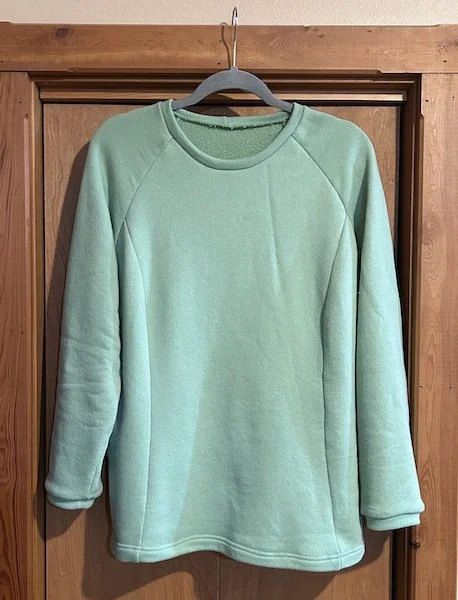
This was not a straightforward make, but that was not the fault of the pattern. The first issue I ran into was trying to find the grain of the fabric. Yes, knit fabric has a grain. Having spent so many years of my life working with knitted fabric, I know exactly how to get my knit fabrics on grain. This is what it looked like when I finally laid down the first pattern piece:
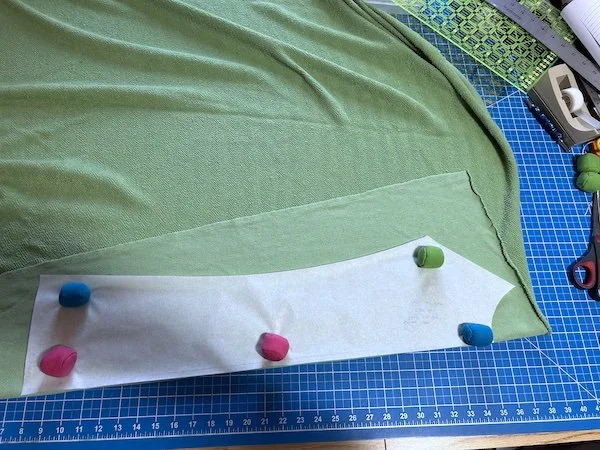
Those of you who sew—and sew with wovens—will find this photo horrifying. I’ve stopped being surprised by this. A lot of commercial knitted fabric is constructed circularly, in a tube, and then the tube is sliced open. This tube was not sliced open in a straight vertical line. I could tell by looking at the edges that it had been sliced open at an angle; hence, the fabric grain was not parallel to the edge of the fabric.
I was using the Tall version of the pattern and I had chosen the longer of the two lengths. I can always shorten something but it’s harder to make it longer. That, combined with the fact that this pattern had a front, a back, two side fronts, and two side backs, combined with the fact that the grain was wonky on my two yards of fabric, left me without enough to make the turtleneck or cowl neck version. I made a simple crew neck instead.
The sleeves were too long, but in my haste to shorten them, I cut off too much. I had planned to hem them but had to put cuffs on instead. However, I didn’t have enough material left for actual cuffs, either, so I did those narrow ones instead. That worked.
It took some pinning and experimenting to figure out what body length looked good. In the end, I settled for a length halfway between the shorter version and the longer version, hemmed on the coverstitch.
I was ambivalent about the Libby at first, but I did wear it for the rest of the day and it met the criteria of being comfortable and unfussy. Part of me wonders if the raglan/princess seam combo is a bit redundant because the princess seams didn’t improve the fit as much as I thought they might. My brain wandered off, thinking about how hard it would be to move them closer to the center so they would fall over the apex of the bust, but I reined it back in after looking at my list again . . .
I will make another one with the cowl or turtleneck and the correct sleeve length. I have some very nice (= higher quality) French terry in two coordinating colors that would lend themselves well to a colorblocked version. All of the pattern pieces have been adjusted as necessary and re-traced, so the pattern is ready to go.
*****
DD#2 is having a bit of a housing crisis at the moment; there is a water leak somewhere in her apartment building and a not-insignificant amount of water is dripping into the room she uses as her office (now un-useable) as well as part of the kitchen. This has been going on since Monday—thank goodness it didn’t happen last week while we were gone—and the building management cannot seem to locate the source of the leak. I suspect they would not be able to locate a prominent body part with both hands, either. Her renter’s insurance will cover a hotel room if necessary, but we hope it doesn’t come to that.