
Embroidering on a Snow Day
Yesterday turned out to be mostly a nothingburger, weather-wise, although we did get snow. I think the worst of the storm went south of us. Wyoming looked like it was getting hit pretty hard.
I decided I didn’t want to work on either the Burnside Bibs or the Rosebud Coat, so I spent the day playing with my embroidery machine. The result is two drawstring bags and a long blog post with lots of opinions. You have been warned.
I haven’t decided if my learning style is at odds with the way information is presented or if the way information is presented is the problem. We’re back to the interfacing issue here. I heard from so many podcast listeners after that episode—and also in my class at Sew Expo—that they have had the same experience I did of not being able to cut through the fog to get clear answers. I still have not been able to source many of the interfacings that Pellon claims they manufacture.
I am finding that sussing out information about machine embroidery has similar pitfalls. There are several variables to conisder when it comes to machine embroidery. (Deana, correct me if I get any of this wrong.)
The fabric being embroidered: Embroidering on knits is different than embroidering on wovens. Embroidering on chiffon is different than embroidering on waxed canvas.
The stabilizer: Stabilizers come in different weights. Some are cut away and some are tear away. Some are water soluble. Some are sticky. I was given the advice, “If you wear it, don’t tear it”—which means that if you’re embroidering on a garment, you should use a cut away stabilizer. Denser stitch patterns require heavier stabilizers. Beyond that, the recommendations are about as vague for stabilizers as they are for interfacings.
The thread: If you’re an older sewist or a garment sewist, you probably use the same thread in top and bobbin. My sense is that the recommendation is starting to change, with the trend moving more toward using a 60wt or 80wt thread in the bobbin no matter what is on top. We do that in my thread class, but I can tell you that stitch integrity suffers when you have a 12wt thread on top and an 80wt thread in the bobbin—that’s simply too large a disparity between sizes. For embroidery, though, having a lighter-weight thread in the bobbin means there is less chance of it showing on top, which means I can use a light gray bobbin thread for just about everything and don’t have to change my bobbin thread every time I change colors on top.
The needles: Embroidery needles come in two main sizes, which are 75/11 and 90/14 but no 80/12. (The larger the numbers, the larger the diameter and eye of the needle. On my industrial Juki, I am routinely up in the 120/19 range.) Quilting needles also come in 75/11 and 90/14 but no 80/12, which makes me wonder, why the discrimination against that size? I asked a Schmetz rep about that once and she couldn’t give me a straight answer. The recommendation for embroidery is to use as small a needle as possible because the needle is puncturing the fabric thousands of times. However, an embroidery needle is preferable because it has a larger eye, which relieves stress on the thread. Bernina sells two packages of embroidery needles. One just says “Embroidery” and is suitable for both woven and knitted fabrics. (I suspect it’s what is known as a “universal needle,” with a hybrid point between sharp and ballpoint.) The other says “Jersey/Embroidery” and has the SUK designation after it, which tells me it is specifically for knitted fabrics. Schmetz sells one “embroidery” needle with a hybrid/universal point. Organ is the only needle company I have been able to find which sells embroidery needles specifically labeled as sharp point. They also manufacture nonstick embroidery needles for embroidering with sticky stabilizers.
I find it helpful to try to establish the “rules” before I try to break them. It would be lovely if the rules were universal. 😑 I do have the Bernina Big Book of Embroidery and it has a lot of good information, but context is crucial.
Kimberbell and OESD (Oklahoma Embroidery Supply and Design) are the two heavy-hitters in the domestic embroidery space. Our store carries OESD stabilizers. The other quilt store in town carries Kimberbell. Wonderfil—my favorite thread company—recently came out with their own line of stabilizers under the Creative Mediums label. They started with seven basics: Applique Transfer Sheet, Rinse Away Design Sheet, Lace Maid, Total Support, Stitch Enhancer, and Stretch Guard. I received a sample pack of this media in a class at BU in June.
I had to get a new suitcase last fall because my old one fell apart. I like the new one very much—it’s from REI—but it lacks the internal zipper pockets of my old one. I find it less easy to separate clean unmentionables from those that have been worn. While I was traveling two weeks ago, I said to myself, “You dingbat. You sew and you have an embroidery machine. You can make yourself some drawstring bags to sort your laundry when you travel.”
I sat down at my embroidery machine yesterday and played around with the built-in designs and fonts. I came up with a stitch pattern for “clean” and one for “dirty.” I put a 75/11 needle into the machine, wound a bobbin with light gray Decobob thread (80wt), cut a bunch of pieces of Kona, and began experimenting. I tried a couple of different threads, several OESD stabilizers, and eventually pulled out the sample pack of Wonderfil stabilizers. The Total Support stabilizer gave me the best result. I will be buying more of it. The thread was Wonderfil’s Polyfast, which is their trilobal polyester and very similar to Isacord or Floriani.
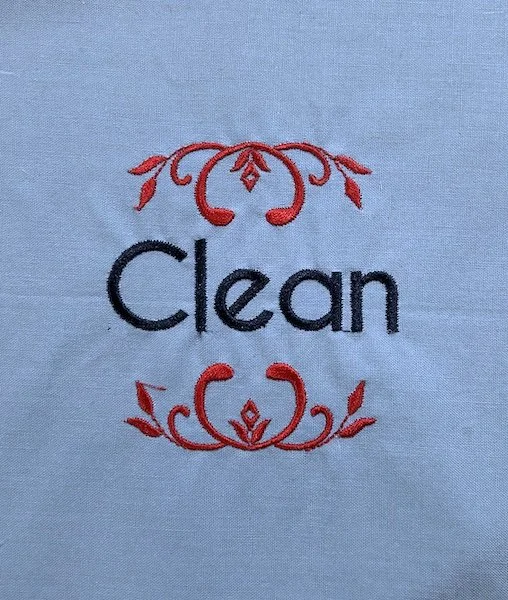
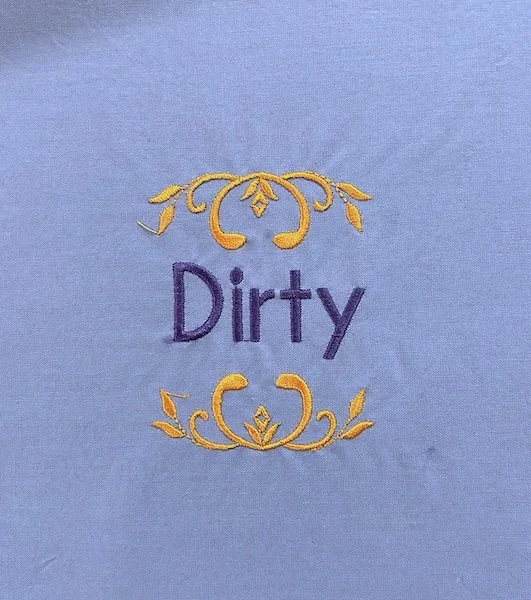
It’s nothing fancy, but it worked. I turned these two pieces into drawstring bags.
Bernina has a website called WeAllSew.com, which has some great sewing, serger, and embroidery tutorials on it. I like tutorials because they provide a practical application of techniques. My biggest beef with those projects is often in the way the instructions are presented. (Shocking, I know.) The instructions list the required materials. I would like to see better explanations of why the designer chose those particular materials, especially when it comes to stabilizers. Or needles. Or thread. That would go such a long way toward helping newbies find their way through the maze.
I don’t need another project right now, but it seems to me that some kind of Interfacing for Dummies or Embroidery for Dummies books would be very helpful. If I wrote them, they would contain a series of tutorials that take novices from beginning projects to more advanced ones with detailed explanations of why certain materials were chosen in a given situation. Am I the only one would need them?