
A Study of Raglan Bust Darts
I have a large library of patterns. That library was easy to build when Joanns put the Big 4/Big 7 on sale every week. I’ve cut back a bit because patterns are more expensive now. Also, indie patterns usually come in the form of PDFs that have to be printed, and all those large-format pages add up. Still, comparing patterns has helped me to better understand fitting—and by extension, pattern drafting—even if I never make the actual garment.
I’ve been looking at and comparing lots of raglan patterns this week. I think I really lucked out with the fit of the Simplicity 8909 raglan. I haven’t had to change anything about the raglan lines or the fit of the upper bodice. Once I took out that center back seam and figured out what size I needed for the front, the pattern was pretty much dialed in. I am still playing with the level of the bust dart but that’s just me being persnickety.
As I mentioned, we traced and sewed the Avid Seamstress Raglan Dress pattern in serger class on Wednesday, and now I’m going to talk about Why Making Garments That Fit Is So Hard.
Size range expansion has been a big topic in the indie sewing pattern world for several years now, with most companies drafting for a wider range of sizes in response to customer requests. In most cases, this is not a small undertaking. It is not a matter of just making the smallest size proportionally bigger. Pattern grading doesn’t work that way. Certain parts of a pattern will change at a different rate than other parts. And when it comes to larger sizes, patternmakers often use a completely different “block” or basic shape than they use for smaller sizes.
Most garment sewists are aware that the size you choose from the pattern does not correspond to the size you wear in off-the-rack clothing. Pattern sizes are almost always larger, so someone who wears a size 12 in RTW may have to make a size 16 from the pattern. This causes a bit of angst for some people, although my advice is to take the emotion and judgment out of the equation and just treat the numbers as data. Some indie designers have gone to alphabet sizing or other systems to get around this issue.
Here is where it gets tricky. Not all indie designers will remember to tell sewists what kind of body the pattern block is designed for. Seamwork is one company that does a fabulous job in this area. Their patterns always include something like the following description:
DRAFTING NOTE: Sizes 00-18 (Misses) are drafted for a C cup. Our size 8 fit model is 5’8”. Sizes 12-30 (Curvy) are drafted for a DD cup. Our size 20 fit model is 5’9”.
That drafting note tells you what bra cup size the pattern is drafted for, which is important information. Most commercial patterns are drafted for a 5'5" fit model with a B-cup bra size. In my years of teaching sewing classes, I have had exactly ONE student who fit that description and who didn’t have to make any adjustments to the pattern before sewing it. And the garment fit her perfectly. She is a unicorn, at least in my classes.
I have noticed that many—most?—owners of indie pattern companies are svelte young women on whom a potato sack would be flattering. Jenny at Cashmerette is one exception, and she has built her entire (very successful) pattern company around patterns for larger-sized and curvy women. Sarai, at Seamwork, is another, but she is taller than average.
I don’t want anyone to think I am picking on The Avid Seamstress patterns here. I like their designs and I think the drafting and instructions are well done. I am using their Raglan Dress pattern to show differences in drafting results, not as an indictment of a bad pattern.
When I began tracing the pattern on Wednesday, I knew right away that I was going to have to make some adjustments to the pattern. For purposes of class, though, I traced it as presented. These are the bust darts:
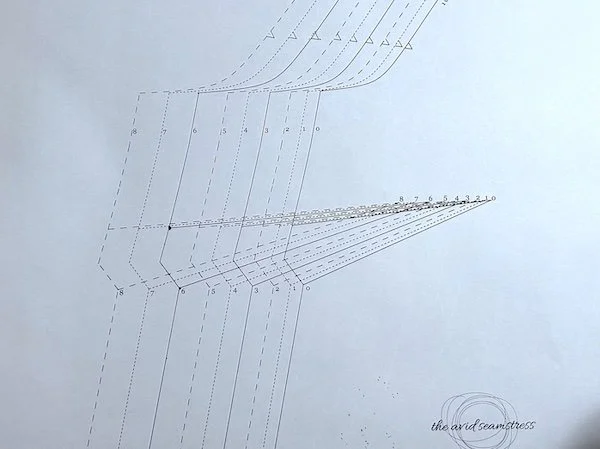
Although it isn’t spelled out on the pattern, in the instructions, or on the website, I suspect this dress has been drafted for that mythical 5'5" woman wearing a B-cup bra. I chose the dress size to trace based on the finished bust measurements of the pattern (body measurement plus wearing ease). No high bust measurements were given. The bodice does fit around my chest, but it doesn’t fit well, and I wasn’t surprised at the fit when I popped on the dress.
In contrast, here are the bust darts for the Simplicity 8909 raglan. I can tell you that this dart intake is about twice that of the dart on the AS Raglan Dress pattern, meaning that the dart is almost twice as deep and provides more room in the bust.
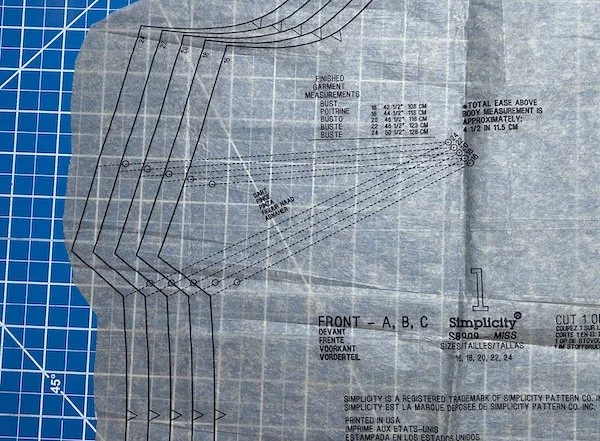
Interestingly, the Simplicity.com website states that “Misses patterns are made for a B cup with 2" (5cm) difference between bust and high bust measurement.” Simplicity says they are using the same drafting yardstick—no pun intended—but the final pattern looks completely different.
If I want to use the Avid Seamstress Raglan Dress pattern, and I probably will, I am going to have to increase the size of the dart. Or use the bodice from the Simplicity 8909 pattern and lengthen it into the same kind of dress. This is why I frankenpattern so much. When I find something that works, I just move it around to different patterns.
I spend a lot of time wondering how to get around these conundrums. I know enough to be able to recognize when a pattern is going to need adjustments even before I make the muslin but I also spend a lot more time looking at an analyzing patterns than the average sewist does. I wonder that anyone is actually able to make garments that fit given all of these variables. If I am missing something obvious, please let me know!