
Having the Right Tool is Important
When I teach my serger mastery classes, I talk about the fact that sewing machines have been around since the latter half of the 1800s. Sergers were invented by the Merrow Company (still in business!) in 1881, although domestic sergers didn’t make it to the home sewing market until the late 1960s. Coverstitch machines have been in use industrially for a while but weren’t available to home sewists until the 1990s.
It’s the last one that I find so fascinating, because I’ve gotten to watch the evolution of coverstitch machines in real time. I bought my first coverstitch machine, a Janome CoverPro 1000cpx, about 15 years ago. That machine had a lot of issues. Facebook had (has) an entire group devoted to that model, with instructions in the files for raising the feed dogs and making other adjustments that should have been done at the factory. I have only ever been able to use it successfully with all the tension dials set to 0—but use it, I did, until I replaced it a few years later with a Janome CoverPro 3000cpx. Janome seems to have worked most of the bugs out of the 3000. I’ve hemmed a lot of T-shirts with both machines.
Coverstitch machines did not come with a lot of educational support. Johanna Lundstrom’s book, Master the Coverstitch, probably kept a lot of people from tossing their machines out the window. And thank goodness for Facebook groups and crowdsourcing and people who were willing to take apart their machines to raise the feed dogs and then tell others how to do the same thing.
Coverstitch machines were invented to meet a functional need—hemming garments—but with their advance into the home sewing market, they have evolved into machines that can also be used to make many kinds of decorative surface design stitches. Gail Yellen is an absolute genius when it comes to pushing the decorative coverstitch envelope.
I now have three coverstitch machines, because my Bernina L890 serger is both a serger and coverstitch. The Bernina can do a few things that the Janome coverstitch machines cannot. The Janome machines have a hard time with decorative threads, mostly due to a design flaw. The looper thread path makes a hard right turn through a metal guide, and that metal guide has a tendency to damage and shred metallic threads. The L890 is much kinder to metallic threads. And the L890 can make a five-thread combo stitch using both the serger and the coverstitch capabilities, which the Janome machines cannot as they are dedicated coverstitch machines.
[There is a point to this blog post, I promise.]
The Bernina L890 was released in May of 2021. Bernina doesn’t often miss the mark when it comes to their products, but that machine has been on the market for five years with only one coverstitch foot—the all-metal foot. Janome, in contrast, has always had a clear plastic foot available for its coverstitch machines. Why does that matter? A coverstitch hem in the round is finished off by stitching over the beginning of the hem by a few stitches. It is impossible to see those stitches underneath a metal foot. It’s why I’ve continued to use my Janome coverstitch machines to hem T-shirts rather than hemming them on the L890. The L890 is the better machine but the Janome, with the clear foot, is easier to use.
Early in 2026, Gail Yellen made a YouTube video announcing that Bernina had come out with a clear coverstitch foot for the L890. (I suspect she’s been leaning on them about this.) The foot promptly sold out. I have been looking for one since then—checking at every Bernina dealer between here and Seattle—to no avail. I ordered one online about six weeks ago and the store owner told me they were backordered, but he had been told by Bernina that they would be available again in May. I got a shipping notice a few days ago so I’ve been expecting the foot to show up in the mail.
My neighbor across the road (hi, Kim!) asked me if I could hem a pair of pants for her. Her daughter is getting married next month and she bought a beautiful pair of pants and a top to wear to the reception. She came over on Saturday and I marked the pants and hung them up in my sewing room. The pants have two layers—a knit inner layer and a slinky outer layer—and I knew I would have to hem at least the inner layer on the coverstitch machine.
[Before anyone asks—no, I do not hem pants and do alterations unless I like you very much, even if it’s a simple job like this one. I have no desire to get into that business.]
I was about to set up the Janome to hem the pants when I got a notice on my phone that the clear coverstitch foot for the L890 had been delivered and was waiting in the mailbox. Yay! Perfect timing! Here are the two feet side by side:
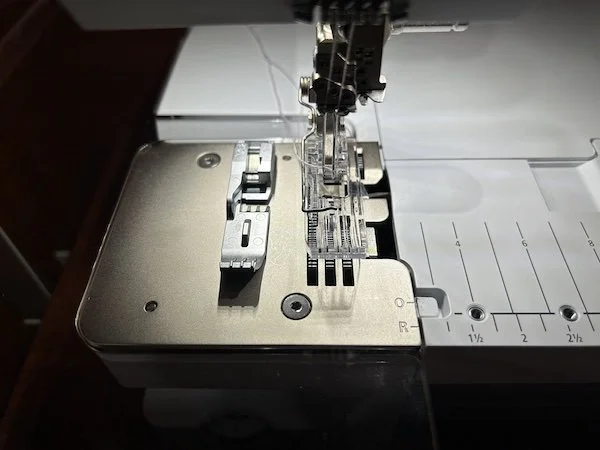
The Bernina is all threaded and ready to go, so I’ll get these pants hemmed and back to Kim.
******
The short load of concrete showed up yesterday morning and the husband got the sonotubes filled. It is still raining, although the rain is supposed to taper off after lunch. Tomorrow is forecast to be sunny and 70F. The fuel supplier is coming tomorrow to bring the new 500-gallon propane tank for the rental house and to move the 250-gallon tank from the rental house to the greenhouse to replace the one that is leaking.