
The Finer Points of Pattern Grading
This post falls under “things I know but sometimes forget when I am in the midst of a project” and it’s going to be a long one. This issue came up in Tuesday’s class on fitting the Cashmerette Concord Tee and I have been mulling it over ever since. I want to address it here because talking through it will help my thought processes going forward.
Pattern companies have become much more size inclusive—both smaller and larger—over the past several years. The indie companies were the first ones to respond to customer requests for expanded sizing, but now the Big 4/7 pattern companies are also offering expanded size ranges.
Generally speaking, most patterns are built for a woman 5'5" tall with a B-cup. If your bust is larger then that, you are usually required to make a full bust adjustment, or FBA. It’s important to note that cup size here refers to dressmaker cup size, not bra cup size. Dressmaker cup size is the difference between high bust and full but measurements. Bra cup size is the difference between full bust measurement and band measurement.
Bust measurement isn’t the only consideration, though, when expanding sizes. And pattern grading does not—should not—consist of making the entire pattern proportionally smaller or larger all the way around as the sizes decrease or increase. Human bodies are not built that way. Some parts change in size at a faster or slower rate than others as the sizes change. Most pattern companies that offer expanded sizing use different “blocks” for different size ranges. The block is the starting form from which each design is drafted.
I did something similar when grading knitting patterns in my Excel spreadsheets. Sizes in one range started with certain assumptions and sizes in a larger range started with different assumptions. That could be another post in itself so I am going to leave that there for now.
[I am trying not to make an encylopedia entry out of this post. There is a lot to unpack here.]
Cashmerette offers a lovely size calculator on their website to help determine what size pattern to make.
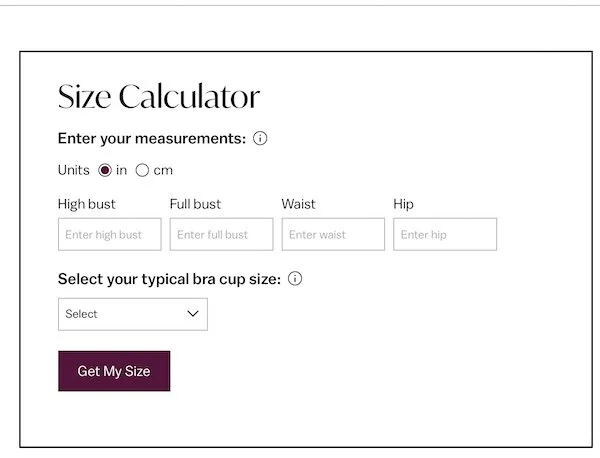
You enter your measurements and your bra cup size and the calculator tells you which pattern pieces to use. My high bust measurement is 38", my full bust measurement is 43", my waist measurement is 37", and my hip measurement is 46". My Wacoal bra cup size is G because of that size difference between band (38") and full bust (43") and because a gene for large Eastern European breasts runs in my family. 😁 The size calculator tells me that I should start with the size 14 bust, grade out to an 18 at the waist, and back to a 16 at the hips.
Those measurements put me in the 12-32 size range—the other range is 0-16—and the E/F cup pattern piece, although I usually go with the G/H pattern piece because I like the extra room there. When I made the Concord Tee, I used the 12-32 pattern and the G/H cup pattern piece and did the suggested grading between sizes. It isn’t really possible to grade between the two size ranges because they are based on different blocks, so if the measurements put you in that situation, you may have to grade manually within your size range (e.g., make the hips a size 18 within the 0-16 range).
When I downloaded the Wexford pattern from the Cashmerette Club last year, I printed the 0-16 pattern for some reason instead of the 12-32 pattern. According to the size chart in the pattern, I could make the size 16 and be fine, so that’s what I did. Because it’s a swing top that isn’t fitted at the waist, the waist measurement is not as critical. I traced the size 16 (not 14) G/H pattern piece, then cut it at the cutting line, lengthened it by 3", and redrew the seamlines to smooth them out.
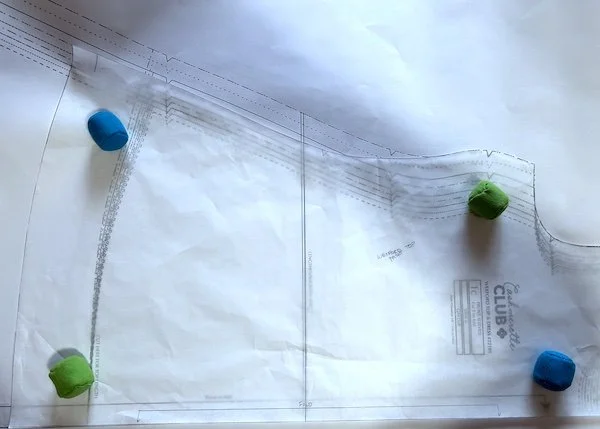
I did not simply add length at the bottom. The lengthen/shorten lines are there for a reason. You can see that there is no bust dart as such in this pattern; it has that “boob bump” to accommodate the bustline and that works fine in knit fabrics.
This size and modification fits me fine. However, I couldn’t stop thinking about the differences in the two pattern blocks and how that would affect the size and pieces I chose, so I had the 12-32 pattern range for the Wexford top printed at the blueprint shop yesterday. I pulled the G/H pattern piece and laid my modified pattern piece on top.
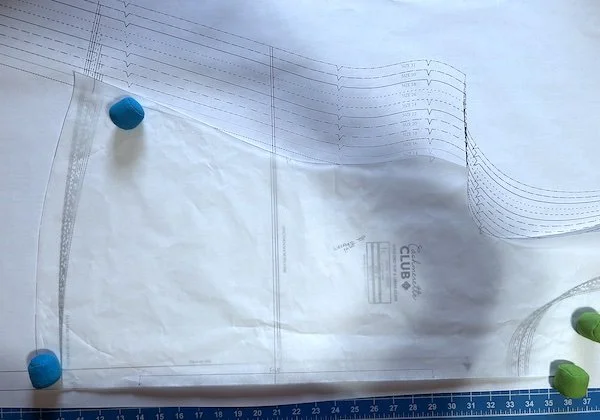
It’s hard to see without a closeup, but in this size range, my pattern piece actually corresponds to the size 12 at the bust. (The two ranges do not correlate one-to-one in sizes.) And I could have saved myself some work by using this pattern piece because the extra length is built in—most of it, anyway.
Cashmerette has a page on their website about choosing your size range. They note that the size 0-16 range has the following characteristics:
The bust darts are slightly higher
There is less ease at the waist and hip (this varies by pattern)
The waists are slightly lower (i.e. less short-waisted)
The front lengths are slightly shorter
In some cases, the side seams are slightly straighter.
This explains why I should stick to the size 12-32 size range: I need lower bust darts, more ease at the waist, and I certainly need the extra length. The higher waist of the 12-32 range also works better for me. I may make another wearable Wexford muslin from my size in the 12-32 range just to compare the fit of the two versions. Knits are very forgiving, so it may be hard to pin down specific differences, but it would be an educational exercise nonetheless.
*****
I canned up 14 quarts of salsa yesterday with one almost-full quart left over that went into the fridge to be eaten this week because it is delicious. (The canner only holds 14 quarts.) I have enough tomatoes ready for another seven quarts or so and will process those today. That puts us at about half the needed amount for this year. I’d like to try to finish the rest next week but I’ll have to see how things go.