
Kit Assembly
I have no idea what happened with yesterday’s blog post, because it didn’t display on the website the way it did in the editor. Software glitches have been rampant lately, and not just in QuickBooks. 🧐
I had no interruptions yesterday and was able to be very productive. The Accuquilt cutter got quite a workout. These are some of the samples for my interfacing class:
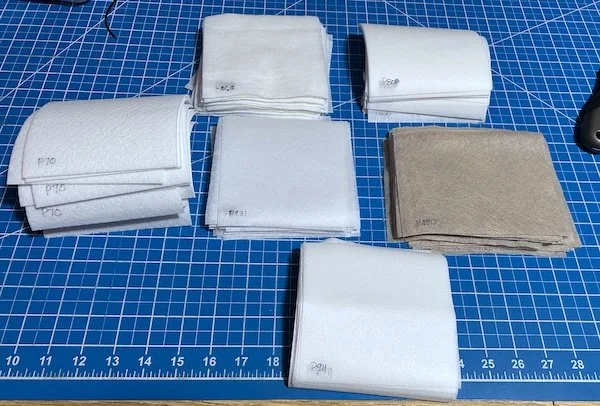
I am very excited about the sewing classes I’m teaching this year. Putting the kits together is taking some time, but I prefer that students work from kits at an event like this. (Students pay a kit fee to the teacher at the beginning of class.) Knowing that the students will have everything they need is safer than hoping everyone will read the supply list and bring the appropriate materials. Believe me, someone always shows up unprepared. I once had a lady bring navy blue sock yarn and size 2 needles to a cabling class where the supply list specifically stated “a light color worsted-weight yarn and size 8 needles.” She had a heck of a time working complicated cables in her yarn.
Prepping for this interfacing class reminds me a lot of writing my finishing book in 1996. Knitting patterns tend to be thin on critical details, and sewing patterns are the same way. Knowledge is assumed rather than explained. When a pattern includes interfacing in the supply list, there is no elaboration on what kind of interfacing. Sewn-in? Fusible? Woven? Non-woven? Knit? Warp insertion? Weft insertion? Are pieces cut with the grain or does grainline not matter? All of these things make a difference, and product labeling often further confuses the issue.
I get the sense that when people see or hear the word “interfacing,” they think of SF101, which is Pellon’s ubiquitous woven interfacing. It’s used in a lot of bag patterns because it’s a great interfacing for quilt cotton. It’s not the right interfacing for every situation, however. For example, I almost always use a fusible knit interfacing for the facings of my woven rayon tops because I like the results.
Hopefully, students will come out of this class better prepared to choose interfacings for their projects. That’s the goal. Sometimes you don’t know what you don’t know.
******
Picking up chicken feed at the farm store is on the list of errands for today, so I will get a chick schedule while I am there. I’ll have to decide what breed of chickens to get this year. (I am leaning toward Barred Rocks, but if I could get Lavender Orpingtons, they might be fun.) We may also need to schedule a butchering date. We have a lot of chickens out there that are old and not laying much. I think we need to cull hard and start over. Supposedly, the USPS has instituted new policies for shipping chicks to avoid the problems we’ve had for the last few years. I’ll believe it when I see it. The USPS is a study in stunning incompetence.
I also have to spend a few days doing some canning when I get back from Sew Expo. We are low on beef, ham, and chicken stock and equally low on beans.