
Threads and Interfacing
I go from not having any blog content to being a Chatty Cathy on steroids. This will be a long post.
I narrowly skirted a teaching disaster yesterday. I am teaching a thread class at Sew Expo, and that class also has a kit. The kit consists of eight 5" squares of interfaced quilting cotton, a couple of appliqué shapes, a thread net, and six spools of various kinds of thread. The six spools come packaged together as 30-yard sample “cops” from the thread company, which has been making these thread kits for me since I began teaching this class. Every so often, I call the teacher coordinator, tell her how many thread kits I need, and the threads show up a few weeks later. I ordered some at the beginning of January knowing I would need them for Sew Expo.
I opened the box yesterday to start assembling the class kits and discovered that the cellophane bags of thread from the thread company contained only four spools, not six. Yikes. I need all six threads or the class material won’t make sense. I called the teacher coordinator at the thread company and sent her a photo. After some sleuthing, she figured our that the shipping department hadn’t looked at the back page of the order form when filling the order.
The thread company will have a booth at Sew Expo, so she is arranging for someone to bring the missing threads with them. I’ll be able to pick them up before class. Whew. Crisis averted.
******
Something has been niggling at me since I started studying up on interfacings. Again, I did the equivalent of a sewing literature review in an attempt to be able to provide information in a coherent format. It isn’t enough just to hand out samples of interfacing in class and identify them as woven, non-woven, or knit. I want to be able to explain why the structure of a particular interfacing makes it suitable for a particular application. Someone is sure to ask that question if I don’t bring it up.
Pellon interfacings are the most widely-available ones here in the US, so I started at their website. May I say that it is mostly useless? I was able to hunt down a chart of their interfacings by name and use, but it’s not on their website. There is also an old Joann Fabrics guide still floating around. And none of these resources do any kind of deep dive into structure.
I have two books by Margaret Komives, which are basically the same book under two distinct covers.
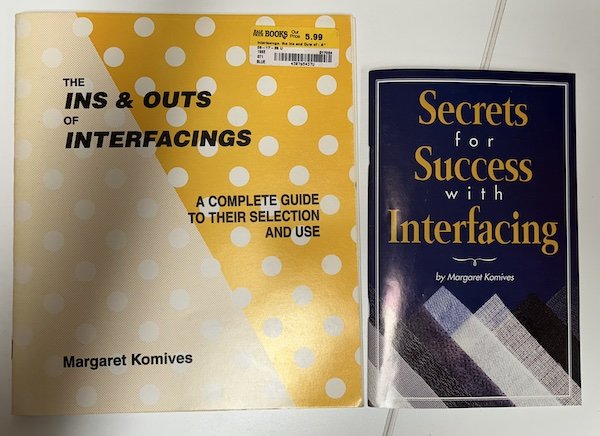
When I bought these books, I recognized Margaret Komives as a contributor to Threads Magazine. (She has since passed away.) In these books, she talks about “weft insertion” and “warp insertion” knit interfacings, but all she says is “They are made on a tricot machine with a warp or weft yarn introduced for varying degrees of stability.”
Problem #1: In my mind, this was a collision of two separate textile disciplines. “Warp” and “weft” are weaving terms. I’ve certainly never seen them in conjunction with handknitting. I do talk about “grain” with regard to knitted fabric, because knitted fabric does indeed have a crosswise and lengthwise grain. If you don’t believe me, sew a jersey T-shirt with the pieces cut off grain and watch as the shirt crawls around your midsection while you wear it. I assumed a “tricot machine” meant a knitting machine, but I was having trouble wrapping my head around how one would insert extra warp threads into fabric made on such a machine.
Problem #2: Komives never fully explains the process of making weft insertion or warp insertion interfacings. The most she does is to include photographs of some of the interfacings showing their structure.
Problem #3: Ever since Margaret Komives first began writing about interfacings, around 1987, the information she presented has been parroted and propagated throughout books and magazines on the topic to this day. I think that is the most maddening thing of all. She gets credit, in most instances, but no one ever goes beyond what Komives said in her books. Has no one else ever been curious about this?
I finally happened upon a website that shed some light on the situation. FabricMart Fabrics has a blog post about knitted fabric in which they illustrate the differences between warp-knitted fabric and weft-knitted fabric. After reading it, I messaged Lily Chin—who knows more about knitting than anyone else on the planet—and she confirmed what I was reading, specifically:
Warp knitting is industrial and only done on machines where each stitch has its own vertical thread and is linked to stitch(es) next door occasionally. Weft knitting is what we do.
Well hallelujah. Now I can present this information in a way that makes sense.
I also happened upon one other nugget of information. Margaret Komives notes in her books that much of the information in them is based on an article she wrote for Threads magazine, issue #10, from April/May 1987. I have the first 15 years or so of Threads magazine back issues in my possession, because my mother subscribed from issue #1 and gave them all to me some years ago. (They don’t leave my house.) I went and pulled the issue in question to read Komives’ article. In the section on knit interfacings, she wrote:
Weft-insertion interfacings are relatively new and could be described as woven knits, as they consist of crosswise (weft) yarns held together by lengthwise lines of warp knitting. This structure combines the softness of knitting with the stability of weaving: lengthwise stability, some crosswise give, and bias stretch.
It sounds like warp- and weft-insertion interfacings have only been around since the 1980s or so, although specialty interfacings, especially fusible ones, haven’t been around much longer than that.
Sarah Veblen has some great photos of the various kinds of interfacing she sells in her shop, but nothing specific about structure. She also wrote an article for Threads Magazine about knit fabrics back in 2001 (issue #97) in which she talks about warp knitting and weft knitting, but I don’t think those terms are widely used because—surely?—I would have run across them at some point. Or maybe everyone knows those terms and no longer feels the need to elaborate on them and I am just late to the party. Someone may take away my master knitter certificate.
Thoughts?